




As the global transition towards sustainable mobility gathers pace, electric and hybrid vehicles are giving motorists a wider choice of technologies focused on improving efficiency, reducing emissions and meeting different driving needs.
However, selecting the right vehicle technology depends largely on individual driving habits, travel distances and the availability of charging infrastructure, according to Electric Vehicle Expert Issa bin Mubarak al Qitaiti.
He said hybrid technology was initially developed to reduce emissions from petrol-powered vehicles and later paved the way for more advanced electric mobility solutions.
Battery Electric Vehicles (BEVs), powered entirely by rechargeable batteries and electric motors, provide a quiet and smooth driving experience with instant acceleration and no direct tailpipe emissions. Their simpler mechanical design can also help reduce maintenance costs.
“Electric vehicles have contributed to a much greater reduction in emissions, potentially exceeding 90 per cent,” Al Qitaiti said, adding that EVs have fewer mechanical components compared with conventional vehicles.
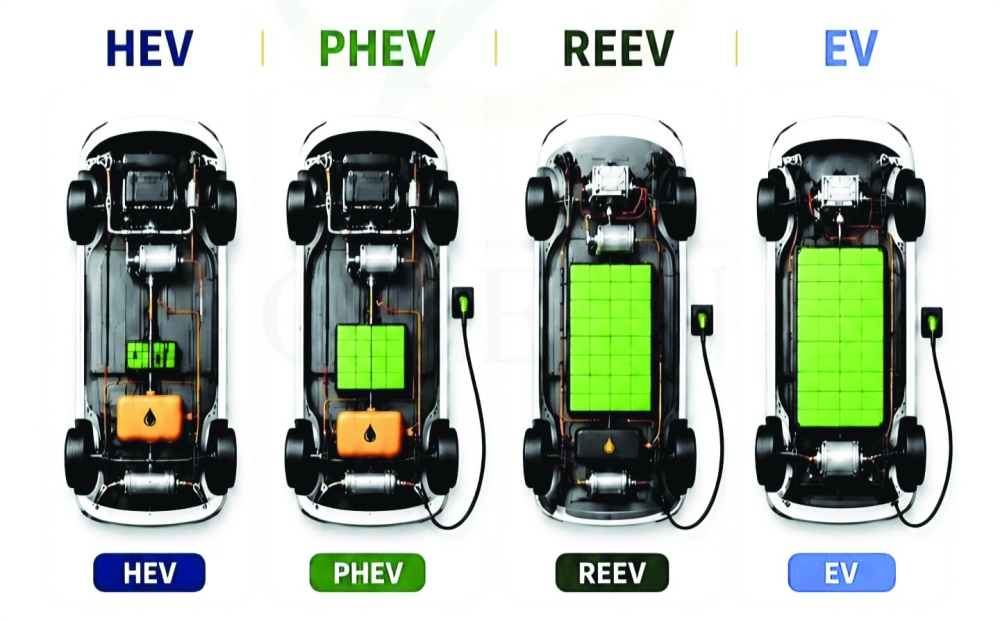
Unlike traditional vehicles that depend on engines and transmission systems to deliver power, EVs send electricity directly to the motor, allowing faster response and smoother performance.
Hybrid Electric Vehicles (HEVs), meanwhile, combine a petrol engine with an electric motor. Their batteries recharge automatically while driving, eliminating the need for external charging. This makes them practical for motorists who frequently travel longer distances.
“The hybrid operates on petrol while charging its battery automatically during driving and use,” Al Qitaiti explained.
Plug-in Hybrid Electric Vehicles (PHEVs) add a charging port to the hybrid system, allowing drivers to recharge the battery externally and travel a certain distance using electric power before the petrol engine takes over.
“Plug-in Hybrid is essentially a hybrid vehicle with a charging port. You can charge it while stationary and then drive using electric power. Once the electric energy is depleted, the petrol engine starts operating,” he said.
Another emerging technology is the Range-Extended Electric Vehicle (REEV), where the electric motor drives the wheels while a petrol engine works only as a generator to recharge the battery. This provides the driving experience of an EV while reducing concerns over range limitations.
Nissan’s e-Power system follows a similar concept, using a petrol engine solely to generate electricity without connecting it directly to the wheels or transmission.

Al Qatiti stressed that there is no single technology suitable for every driver. “When people ask me what the best electric car is, I always tell them that it depends on your needs. Do you need it for city driving or long-distance journeys? Your needs determine the type of vehicle you should use.” For Oman, where long-distance travel is common, he believes hybrid vehicles currently offer a practical solution due to their ability to cover more than 1,000 kilometres without dependence on charging stations.
While charging infrastructure remains a challenge for wider EV adoption, Al Qitaiti expects improvements as investment increases and more companies enter the market.
The future of mobility, he said, is likely to involve multiple technologies rather than a single solution, with each designed to match different driving patterns, distances and infrastructure requirements.
FACTS
- HEV (Hybrid Electric Vehicle) - Combines a gasoline engine and an electric motor to reduce fuel consumption and emissions - PHEV (Plug-in Hybrid Electric Vehicle)
- Blends the best of both worlds. It runs on electricity first and uses gasoline when needed
- REEV (Range-Extended Electric Vehicle) - Runs fully on electricity. The gasoline engine acts solely as a generator to charge the battery - EV (Electric Vehicle)
- Relies solely on electricity to power the motor and does not use gasoline at all
Oman Observer is now on the WhatsApp channel. Click here